Choosing the wrong flooring for a Burlington home isn’t just a design mistake; it’s a structural gamble against Ontario’s unforgiving humidity swings. You’ve likely spent hours scrolling through contradictory price estimators and vague forum posts, only to feel more uncertain than when you started. It’s frustrating to plan a significant renovation when the “all-in” price seems to change with every click. We’ve developed this 2026 price guide to eliminate that ambiguity, providing a clear-eyed look at the real cost to install engineered hardwood floors in the GTA. You deserve to move forward with a sense of security and expert-led progress.
This guide details everything from the meticulous subfloor preparation required for a level finish to the nuances of premium European Oak. We’ll explore the material and labour variables that define a high-end installation, ensuring you know exactly what to ask a contractor before the first plank is laid. By the end, you’ll understand why engineered hardwood is the superior choice for our local climate and how to budget for a transformation that lasts a lifetime. Whether you’re looking for entry-level durability or bespoke wide-plank aesthetics, this breakdown provides the consistency and transparency needed for a successful project.
Key Takeaways
- Learn how the thickness of the wear layer and core construction determine the long-term durability and stability of your planks in the Ontario climate.
- Understand the comprehensive cost to install engineered hardwood floors by breaking down material grades, professional labour rates, and essential site preparation.
- Compare the technical differences between glue-down, nail-down, and floating methods to choose the right installation strategy for your specific subfloor.
- Identify potential “hidden” expenses, such as subfloor levelling and old material disposal, to ensure your renovation budget remains accurate and transparent.
- Discover how professional installation safeguards your manufacturer’s warranty and enhances the long-term resale value of your property in the GTA.
Understanding the Total Investment for Engineered Hardwood
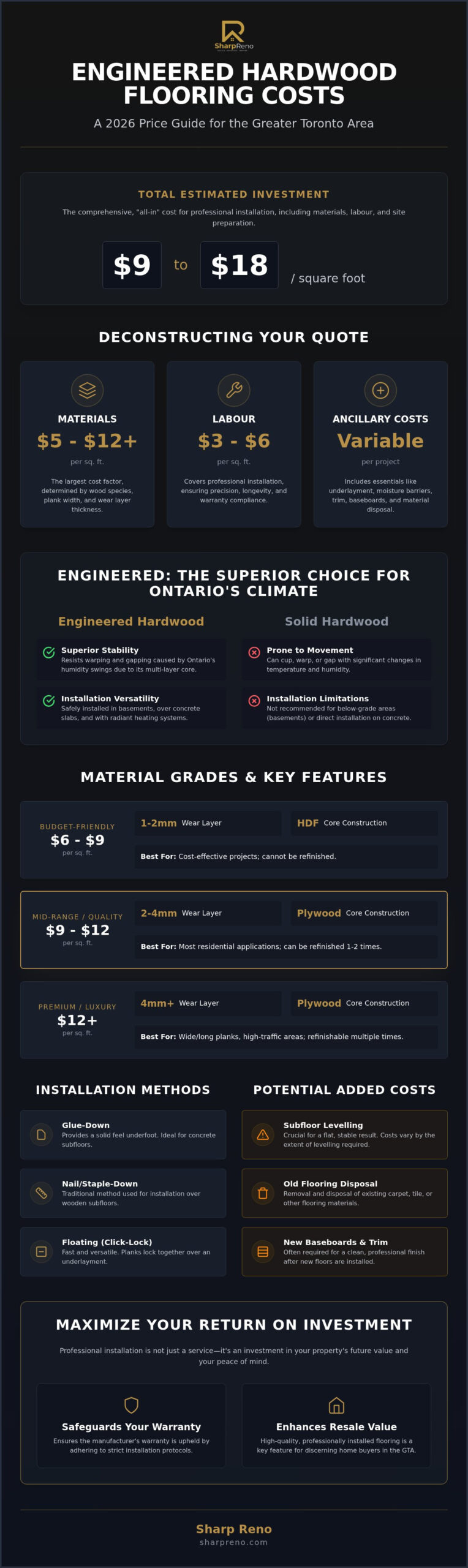
Engineered wood flooring consists of a genuine hardwood veneer bonded to high-density layers, creating a plank that looks identical to solid timber but behaves with far greater resilience. For homeowners in the GTA, understanding the total investment requires looking beyond the sticker price of the planks. In 2026, the typical market range for the comprehensive cost to install engineered hardwood floors in Ontario spans from $9 to $18 per square foot. This “all-in” approach covers everything from initial site preparation to the final trim work, ensuring your project remains on track without the stress of unexpected financial surprises.
To gain a clearer perspective on how these variables influence your final quote, watch this expert breakdown:
The Components of a Flooring Quote
A professional quote is built on three distinct pillars. Material costs generally represent the largest portion, with Ontario market prices ranging from $5.00 for entry-level options to over $12.00 for premium wide-plank selections. Labour fees for standard professional installation in the region usually sit between $3 and $6 per square foot. Finally, ancillary costs cover essential details like moisture barriers, transitions, and baseboards. These elements are vital for a polished look and a long-lasting result. At Sharp Reno, we believe transparency in these categories is the foundation of a successful partnership.
Engineered vs. Solid Hardwood: A Value Comparison
Solid hardwood often struggles with the dramatic seasonal humidity shifts common in Burlington and Oakville. Engineered planks offer superior dimensional stability, making them the preferred choice for homes with radiant heating or those being installed directly over concrete slabs in basements. This structural advantage allows for a seamless flow throughout the home, from the main floor to the lower levels. This versatility doesn’t just simplify the installation process; it protects your long-term investment. High-quality flooring remains a key driver for property value in the Burlington market, offering a sophisticated aesthetic that appeals to discerning buyers while maintaining its structural integrity for decades. Choosing the right material from the start prevents the costly repairs often associated with solid wood’s tendency to cup or gap during a dry Canadian winter.
Breaking Down Material Costs: From Entry-Level to Luxury Planks
Material selection dictates both the aesthetic appeal and the long-term durability of your investment. When calculating the total cost to install engineered hardwood floors, the quality of the plank itself is the primary variable. The most significant price driver is the wear layer; this is the top slice of genuine wood that can be sanded and refinished. A thicker wear layer ensures your floors can withstand decades of foot traffic and periodic restoration. Core construction also plays a vital role. While High-Density Fibreboard (HDF) offers affordability, multi-layer plywood cores provide the superior stability required for Ontario’s shifting humidity levels.
Beyond the internal structure, dimensions and species significantly impact the final quote. Wide planks and long boards require higher-grade timber and more complex manufacturing, driving up the per-square-foot price. While domestic species like Oak and Maple remain popular, exotic hardwoods or specialized cuts like rift-sawn timber carry a premium price tag. Choosing the right material grade is a balance of your current budget and the future lifespan of your home. Homeowners who are also weighing cost-effective alternatives should explore the best laminate flooring options for Canadian homes, which can offer impressive durability and aesthetics at a lower price point.
Budget-Friendly Options ($6 – $9 per sq. ft.)
Planks in this category typically feature a thin wear layer of 1mm to 2mm and shorter overall lengths. They often utilize an HDF core and a click-lock system. While cost-effective, these floors generally cannot be refinished and are best suited for low-traffic areas or guest rooms. Common species like Red Oak are prevalent here, often displaying more knots and natural character marks than higher-grade selections. This tier provides an accessible entry point for those focused on immediate aesthetic updates.
Mid-Range Quality ($10 – $14 per sq. ft.)
This tier represents the “sweet spot” for many Burlington homeowners. These planks offer a substantial 3mm to 4mm wear layer, allowing for one or two professional refinishing cycles over their lifespan. You’ll find wider planks, typically 5 to 7 inches, and more consistent grading that results in a cleaner, more uniform appearance. The core is almost always multi-ply wood, offering excellent resistance to warping. If you are planning a comprehensive renovation, integrating these high-quality materials ensures a cohesive look throughout your flooring design and installation project.
Premium and Custom Luxury ($15+ per sq. ft.)
Luxury engineered hardwood rivals solid wood in every metric. These planks boast wear layers of 5mm to 6mm and feature advanced core technology for maximum stability. This category includes sought-after European White Oak, exceptionally long lengths, and bespoke oil or wire-brushed finishes. The meticulous craftsmanship involved in these products justifies the higher price point for those seeking an uncompromising home aesthetic and the highest possible return on investment. These floors are built to be a permanent legacy in your home, combining artisan beauty with disciplined execution.
Installation Labour: Comparing Glue-Down, Nail-Down, and Floating Methods
Professional labour acts as the bridge between a crate of premium planks and a flawless living space. In the GTA, contractors typically structure their pricing on a per-square-foot basis, reflecting the specific technical requirements of your subfloor and the chosen material. The total cost to install engineered hardwood floors remains highly dependent on the mechanical method used to secure the wood. While a standard straight-lay pattern proceeds efficiently, intricate pattern work like herringbone or chevron can effectively double the labour investment. These designs require meticulous cutting and exact alignment. Engaging a trusted renovation contractor in Oakville ensures these complex layouts are executed with the precision necessary to maintain both your warranty and your aesthetic vision.
Floating Floor Installation
Floating floor installation offers the most streamlined timeline and a budget-friendly entry point. In this method, planks click together over a specialized underlayment without being fixed directly to the subfloor. It is an excellent solution for basement renovations where a moisture barrier is essential. Homeowners can expect labour rates between $2.50 and $4.00 per square foot for this approach. It provides a clean finish and allows for the natural expansion of the wood, though it may lack the acoustic “heft” of fixed methods. This speed makes it ideal for quick transformations.
Nail-Down or Staple Installation
Nail-down or staple installation is the traditional standard for most Ontario residential projects featuring plywood subfloors. This method involves mechanically fastening each plank, resulting in a stable, permanent feel underfoot. It eliminates the “hollow” sound sometimes associated with floating floors. Professional labour for this method typically ranges from $3.50 to $5.00 per square foot. It is a disciplined, time-tested technique that ensures long-term consistency in high-traffic areas. The result is a floor that feels solid and integrated into the home’s structure.
Full Glue-Down Installation
Full glue-down installation is the premium choice for challenging environments. It is often a technical requirement for concrete slabs or homes featuring in-floor radiant heating systems. This method requires specialized, high-performance adhesives that add to the material and labour budget. Because the process is slower and requires meticulous adhesive application to avoid surface contamination, labour expectations sit between $4.50 and $6.50 per square foot. While it is the most intensive method, it provides the ultimate in stability and sound dampening. It is a sophisticated solution for the most demanding architectural requirements.
Site-Specific Factors That Influence Your Final Quote
The physical environment of your Burlington home often holds the most significant influence over your final budget. Beyond the choice of planks, site-specific variables can alter the total cost to install engineered hardwood floors significantly. Demolition is the first hurdle. Removing old carpet is relatively straightforward; however, chipping away existing ceramic tile or glued-down hardwood requires intensive labour and specialized disposal fees. These preparatory steps ensure a clean slate for your new investment, preventing old debris from compromising the new installation. If you’re ready to see how these factors apply to your space, book a professional flooring assessment to get a precise, transparent estimate.
Subfloor Preparation and Levelling
Precision is non-negotiable for a successful installation. Engineered wood requires a remarkably flat surface, typically requiring a tolerance of no more than 3/16 of an inch over a 10-foot span. In many older Burlington residences, natural settling has created dips and peaks that must be corrected. Addressing these issues involves the application of self-levelling compounds or the installation of new plywood underlayment. While these steps are often considered “hidden costs,” skipping them leads to planks that bounce, creak, or eventually fail. A stable foundation is the only way to guarantee the long-term durability of your floor.
The Condo Factor: Burlington Waterfront and Beyond
Working in high-rise developments along the waterfront introduces unique logistical layers. Most Burlington condo boards mandate strict sound-dampening underlayment with high Impact Insulation Class (IIC) ratings to minimize noise transfer between units. Additionally, the logistics of elevator bookings, limited work hours, and specific insurance requirements for contractors can increase the total labour time. These constraints require a disciplined approach to project management to ensure the transformation proceeds without friction. Professional installers familiar with local building bylaws can navigate these requirements efficiently, saving you from potential fines or project delays.
Trim, Moulding, and Transitions
A truly sophisticated renovation is defined by its edges. Integrating new flooring often necessitates replacing baseboards and shoe moulding to achieve a seamless, high-end look. Transition strips are equally vital where floor heights change between rooms, such as moving from a hardwood hallway into a tiled bathroom. For a truly bespoke finish, custom-stained vents and registers ensure the floor remains the focal point without being interrupted by standard metal grates. These finishing touches represent a small percentage of the budget but provide the polished, artisan feel that distinguishes a professional project from a standard one.
Maximizing ROI with Professional Flooring Installation in the GTA
Investing in premium materials is only half the battle; the true value of your project is unlocked through professional execution. When calculating the total cost to install engineered hardwood floors, homeowners must consider the long-term protection of their investment. Most premium manufacturers explicitly state that their warranties are only valid if the product is installed according to strict industry standards. A professional team ensures these criteria are met, safeguarding you against manufacturing defects that might otherwise be your financial responsibility. Beyond protection, a flawless floor significantly boosts home resale value in Burlington, as discerning buyers recognize and pay a premium for meticulous workmanship.
Efficiency also drives ROI. If you’re already planning a kitchen renovation, integrating the flooring work into the larger project schedule drastically reduces logistical headaches. Bundling services allows for coordinated delivery times, shared disposal bins, and a singular point of accountability. This streamlined approach prevents the “stop-and-start” delays that often plague multi-contractor projects, ensuring your home returns to a state of calm, expert-led progress as quickly as possible.
Why DIY Often Costs More in the Long Run
The allure of saving on labour often masks the hidden expenses of a DIY attempt. Precision matters. Common errors, such as inadequate expansion gaps or the incorrect use of adhesives, can lead to buckling and gaps within a single season. The specialized tools required, including moisture meters, jamb saws, and pneumatic floor nailers, can cost hundreds of dollars to rent or purchase. A professional service provides a “done-for-you” experience with a guaranteed timeline, eliminating the stress of a half-finished living room and the potential cost of hiring a pro to fix a failed DIY attempt later.
Before signing any flooring contract, ensure you’ve checked these essentials:
- Does the quote explicitly include subfloor levelling and preparation?
- Are transition strips and baseboard installations detailed in the scope?
- Has the contractor confirmed the required acclimation period for your specific planks?
- Is the waste disposal and site cleanup included in the final price?
Start Your Transformation with Sharp Reno
We invite you to explore our 2026 Flooring Buying Guide for deeper insights into material selection and design trends. At Sharp Reno, we take quiet pride in our reputation as a proven leader in the GTA renovation market. Our commitment to meticulous craftsmanship ensures that every plank is laid with disciplined execution and an unwavering dedication to your vision. Contact us today for a comprehensive, transparent consultation, and let us guide you through a successful home transformation with professional confidence.
Investing in Lasting Elegance for Your Burlington Home
Transforming your space with high-end flooring is a sophisticated journey that requires a balance of aesthetic vision and technical precision. From selecting the ideal wear layer to understanding the mechanical requirements of your subfloor, every decision contributes to the final outcome. We’ve explored how material grades and professional labour rates define the true cost to install engineered hardwood floors in the GTA. This knowledge empowers you to plan your renovation with confidence, ensuring your investment remains stable against our local climate shifts. A disciplined approach to material selection and installation method is the only way to guarantee long-term durability.
With over 10 years of experience serving Burlington, Oakville, and Hamilton, Sharp Reno specializes in high-end residential transformations that prioritize meticulous craftsmanship and transparent communication. Our team of seasoned professionals is ready to guide you through a seamless, expert-led execution of your flooring vision. We invite you to Get a Transparent Quote for Your Flooring Project today. Let’s move away from the stress of renovation and toward the excitement of a beautifully realized home. Your vision for a polished, durable interior is well within reach.
Frequently Asked Questions
Is engineered hardwood cheaper to install than solid hardwood?
Engineered hardwood often provides a more cost-effective installation path compared to solid wood. While material costs vary by grade, the versatile installation methods of engineered planks, such as floating or click-lock, can significantly reduce the total labour hours required. Solid hardwood typically necessitates a plywood subfloor and a meticulous nail-down process, which increases the time spent on site. This efficiency helps manage the total cost to install engineered hardwood floors while maintaining a premium aesthetic.
How much does it cost to install engineered hardwood per square foot in Ontario?
The total cost to install engineered hardwood floors in Ontario is influenced by material quality, labour complexity, and necessary site preparation. Industry averages for the GTA reflect a broad range that covers entry-level products up to bespoke luxury selections. Your final investment will depend on the wood species chosen, the thickness of the wear layer, and whether your home requires subfloor levelling or moisture barriers. We provide transparent, comprehensive quotes that detail each of these variables for your specific project.
Can I install engineered hardwood floors over a concrete basement floor?
Yes, engineered hardwood is specifically engineered for success on concrete substrates, making it the premier choice for Burlington basement renovations. Unlike solid wood, which expands and contracts excessively with moisture, the layered core of engineered planks provides essential dimensional stability. To ensure a successful transformation, professionals typically use a floating installation with a high-quality moisture barrier or a full glue-down method using premium, moisture-resistant adhesives. This protects your investment from potential subfloor dampness.
Do I need to acclimate engineered hardwood before installation?
Professional standards require an acclimation period of several days before the installation begins. Even though engineered wood is more stable than solid timber, the planks must reach an equilibrium with your home’s specific temperature and humidity levels. Skipping this crucial step can lead to structural issues like gapping or cupping shortly after the project is completed. We ensure all materials are delivered with sufficient lead time so they can settle properly within your unique living environment.
How much extra flooring should I order for waste and cuts?
We recommend ordering a surplus of material to account for cutting waste and natural board variations. For a standard straight-lay installation, a waste factor of five to ten percent is typically sufficient. However, if your project involves intricate patterns like herringbone or chevron, this allowance should increase to approximately fifteen percent. Having this reserve ensures that your installers have enough high-quality planks to maintain a consistent grain pattern and provides a small stock for any future repairs.
Does the cost of installation include removing my old carpet?
Removal and disposal of existing flooring are typically structured as separate line items within a renovation contract. While carpet removal is a relatively straightforward process, replacing ceramic tile or older glued-down hardwood requires more intensive labour and specialized disposal equipment. Clarifying these site-specific factors during the initial quote ensures your budget remains transparent. A comprehensive service usually handles the entire process, from the initial demolition to the final site cleanup, providing a stress-free experience.
How long does it take to install 1,000 square feet of engineered wood?
A standard 1,000-square-foot installation usually requires three to five business days to complete. This timeline encompasses the essential subfloor preparation, the installation of the planks, and the fitting of baseboards and transitions. Complex layouts or full glue-down methods may extend this duration. We prioritize a disciplined execution to ensure the project stays on schedule, allowing you to return to your routine with a beautifully transformed space in a predictable and well-organized timeframe.
Is it worth paying more for a thicker wear layer?
Investing in a thicker wear layer is a strategic decision for long-term home value and durability. Planks with a substantial wear layer can be professionally sanded and refinished multiple times, which can effectively double or triple the floor’s lifespan compared to budget options. This longevity is particularly valuable in high-traffic areas of your Burlington home. While the initial investment is higher, the ability to restore the wood’s original lustre decades later provides a superior return on investment.